Repair agent. Most appliance faults don't need an engineer. This phone line knows which ones do.
A production-deployed voice agent for appliance manufacturers and service networks. Customers call when their dishwasher won't drain or their oven throws an error code. The agent screens for safety, retrieves the right repair guide from a 304-document knowledge base, walks the caller through it, and books an engineer only when it's actually needed. Live, EU-hosted, EU Right-to-Repair ready.
This is what your customer actually hears.
Real audio from the production stack. The agent opens every call with an EU AI Act disclosure, a recording notice, a bilingual offer, and a safety pre-screen, all in one warm utterance.
Every engineer dispatched for "no fault found" costs about the same as a new washing machine.
A typical regional service operator dispatches ~500 in-warranty calls a week. Industry benchmarks show 25–35% result in a fault the customer could have resolved over the phone. The marginal cost of an avoidable truck roll (van, technician time, parts pre-allocation) sits around €80–€130.
Built for the people who carry the cost of every unnecessary engineer visit.
If your business pays for vans, technicians, parts and customer waiting time, the math works. Four operator profiles where the agent pays for itself within the first month.
Appliance manufacturers
Service is now their second-fastest-growing P&L line. The agent scales it without proportionally scaling call-centre headcount.
Service networks
Authorised repair franchises paid per dispatch but bearing the no-fault-found cost. Triage at the front door means fewer truck rolls for nothing.
Warranty insurers
Loss-ratio reduction by deflecting recoverable claims. The voice agent doubles as compliance evidence.
White-goods retailers
Post-purchase support is the highest-margin moment they're worst at delivering. The agent becomes the after-sales front line.
July 2026 turns a "nice to have" into a compliance deadline.
The EU Right to Repair Directive (2024/1799) must be transposed by 31 July 2026. Washing machines, dishwashers, fridges, freezers and vacuum cleaners are in scope. Manufacturers must make repair information accessible and demonstrate consumer benefit, and a voice agent answers all three obligations at once.
✕ Without the agent
- 30–40% of in-warranty truck rolls find no fault or a user-recoverable one
- 67% of out-of-hours calls go to voicemail and are never recovered
- Average EU service-centre wait time is 6–14 minutes
- No structured transcript means no compliance evidence
✓ With the agent
- Triages every call and walks the caller through their own appliance's fault
- Picks up in under two seconds, at any hour, in their language
- Books a technician only when the fault actually requires one
- Every call is a structured transcript, audit trail by default
Speech-to-speech audio, hybrid retrieval, EU-hosted by default.
No cascade. The realtime model handles the voice (one sub-processor in the audio path). Tools live as Edge Functions in Frankfurt. The knowledge base is hybrid RAG: vector + full-text, fused with reciprocal rank.
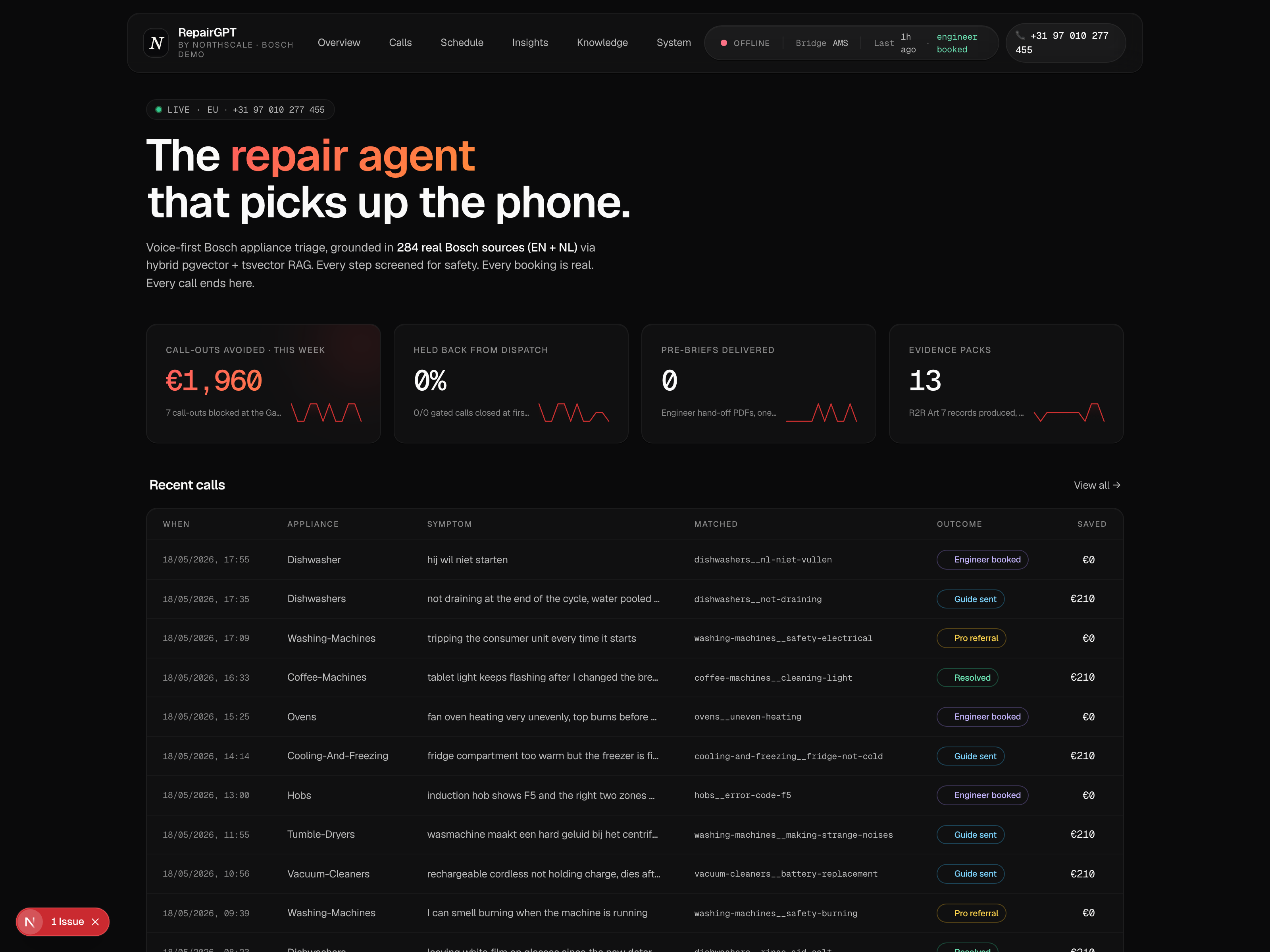
Every call. Every tool trace. Every avoided truck roll. Audit-ready by default.
The dashboard isn't a monthly report. It's the same database the agent writes to in real time. Containment, dispatches, knowledge-base coverage and retrieval accuracy, all live.